
The U.S. Department of Homeland Security (DHS) extended the REAL ID enforcement deadline from May 3, 2023, to May 7, 2025.
_Source: https://dps.mn.gov/divisions/dvs/real-id/Pages/default.aspx_
REAL ID Ready? Minnesotans Have Options
Beginning May 7, 2025, Minnesotans, 18 years of age or older, will not be able to use their standard driver’s license or identification card to board domestic flights or enter certain federal facilities. Instead, they will need one of three options:
- Minnesota REAL ID driver’s license or identification card.
- Minnesota enhanced driver’s license or identification card.
- Other federally-approved forms of identification. They are listed online here, but include:
- U.S. passport or passport card.
- Foreign government-issued passport
- U.S. Citizenship and Immigration Services Employment Authorization Card (I-766)
- Permanent resident card
- Border crossing card
- Federally recognized, tribal-issued photo ID
- U.S. Department of defense ID, including IDs issued to dependents
If you are not sure which license type is right for you, select the Help Me Choose a Type of License or ID tool at drive.mn.gov.
What is REAL ID?
Passed by Congress in 2005, the REAL ID Act established security standards for state-issued driver’s licenses and identification cards.
When you apply for a REAL ID driver’s license or ID card you must provide:
- 1 proof of identity, date of birth and legal presence document.
- 1 proof of social security number document.
- 2 proof of current Minnesota residency documents.
The U.S. Department of Homeland Security extended the deadline for federal enforcement of REAL ID to May 7, 2025.
Check for the Star
Not sure if you have a REAL ID driver’s license or ID card?
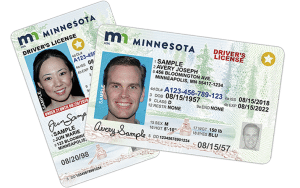
- REAL ID: Minnesota REAL ID driver’s licenses and identification cards display a star.
- Enhanced: Enhanced driver’s licenses and identification cards display the words “Enhanced Driver’s License” or “Enhanced Identification Card” and a U.S. flag**.** Cards issued after Jan. 1, 2021, also display the star to show the card meets REAL ID requirements.
- Standard: A standard driver’s licenses or identification card displays the words “Not for Federal Identification”.
You can verify the type of card you have online at drive.mn.gov. Select More Driver Services from the Driver Services panel and click the Driver’s License Status link.
REAL ID Airport Office Open to Serve Minnesota Airport Travelers
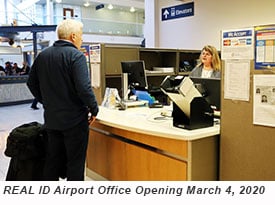
Minnesota airport travelers are able to apply for their REAL ID inside the Minneapolis-St. Paul International Airport’s (MSP) Terminal 1.
The REAL ID Airport Office accepts Minnesota REAL ID applications Monday-Friday, 9 a.m. – 5 p.m. by appointment only. Minnesotans can schedule their appointment for the day they fly out of MSP Terminal 1 online at drive.mn.gov by selecting Apply for a REAL ID at MSP Airport located on level 3 between the gold and green ramp.
Minnesotans should complete the online pre-application before their appointment and double-check their required documents to make sure they have what they need for their application. This will prevent the need for a second visit.
Only One of the Two REAL ID Required Residency Documents can be a Financial Document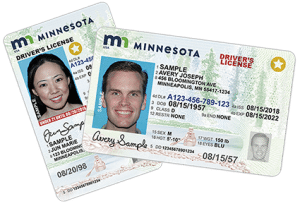
The REAL ID Required Documents list previously indicated that an applicant was able to use two financial documents – such as a bank statement, canceled check, or credit card statement – for both proof of residency documents.
DVS reviewed the Federal Real ID documentation requirements and determined that only one financial document may be used for proof of residency. The second document must be another acceptable document from the REAL ID list. The Required Documents list has been updated on the website.
U.S. Department of Homeland Security Reminder: REAL ID and Passports are not Your Only Options Come May 7, 2025
The U.S. Department of Homeland Security is reminding everyone that there are options for federally-approved forms of identification in addition to a REAL ID. Beginning May 7, 2025, a REAL ID-compliant license or ID, enhanced driver’s license or ID, or another acceptable form of identification will be required to fly domestically and enter federal facilities.
The U.S. Transportation Security Administration accepts several other forms of identify documents. They are listed online here, but include:
- U.S. Department of defense ID, including IDs issued to dependents
- Permanent resident card
- Border crossing card
- Federally recognized, tribal-issued photo ID
The federal REAL ID Act does not require individuals to present identification where it is not currently required to access a federal facility, such as to enter public areas of the Smithsonian.
Important Things to Remember
-
Beginning May 7, 2025, every air traveler 18 years of age or older will need a REAL ID, enhanced driver’s license or ID, passport or another acceptable form of ID to fly within the United States or enter federal facilities.
-
Minnesotans will be able to use their standard licenses and ID cards for federal purposes, including boarding domestic flights, until May 7, 2025.
-
REAL ID applicants should be sure to have all required documentation with them at the time of application. Visit the Required Documents page for a full list.
Minnesota Issuing REAL ID Driver’s Licenses and ID Cards as of Oct. 1, 2018
With the launch of a new driver’s license system Oct. 1, 2018, Minnesotans now have the option to apply for a REAL ID-compliant driver’s license or ID card.
To help reduce wait times, please consider the pre-application feature that allows you to enter a significant portion of your driver’s license or ID card application online – including REAL ID applications – reducing the time spent in driver’s license offices. It’s a good way to ensure you have all necessary documents ready when you visit a driver’s license office.
REAL ID Scoreboard
As of December 1, 2023, 37.31 percent of Minnesota driver’s license and identification card holders are currently REAL ID ready.
- 37.31 percent on Dec. 1, 2023
- 37.21 percent on Nov. 2, 2023
- 37.10 percent on Oct. 2, 2023
- 36.91 percent on Sept. 5, 2023
- 36.69 percent on Aug. 1, 2023
- 36.28 percent on June 1, 2023
- 36.04 percent on May 1, 2023
- 35.01 percent on March 9, 2023
- 34.76 percent on Feb. 9, 2023
- 34.50 percent on Jan. 9, 2023
- 34.17 percent on Dec. 9, 2022
- 33.81 percent on Nov. 15, 2022
- 29.83 percent on Oct. 28, 2022.
- 29.52 percent on Feb. 1, 2022.
- 28.96 percent on Jan. 1, 2022.
- 28.45 percent on Dec. 1, 2021.
- 27.95 percent on Nov. 1, 2021.
- 27.42 percent on Oct. 1, 2021.
- 26.89 percent on Sept. 1, 2021.
- 24.64 percent on July 31, 2021.
- 23.28 percent on March 31, 2021.
- 21.46 percent on Feb. 28, 2021.
- 20.74 percent on Jan. 31, 2021.
- 20.16 percent on Dec. 31, 2020.
- 19.56 percent on Nov. 30, 2020.
- 19.09 percent on Oct. 31, 2020.
- 18.37 percent on Sept. 30, 2020.
- 17.60 percent on Aug. 31, 2020.
- 16.76 percent on July 31, 2020.
- 15.97 percent on June 30, 2020.
- 15.08 percent on May 31, 2020.
- 14.95 percent on April 30, 2020.
- 14.96 percent on March 31, 2020.
- 13.62 percent on Feb. 28, 2020.
- 12.04 percent on Jan. 30, 2020.
- 10.72 percent on Jan. 1, 2020.
- 9.72 percent on Nov. 27, 2019.
- 8.91 percent on Nov. 1, 2019.
- 7.8 percent on Sept. 27, 2019.
Past Updates
TO : Interested Parties
FROM: Matt Burress, Legislative Analyst (651-296-5045)
RE : REAL ID Act implementation in Minnesota – January 2017 update
This memo provides information on federal REAL ID Act legislation and activity in Minnesota. It is revised from previous versions (most recently produced January 6, 2016) and is current with information obtained as of January 6, 2017. A general summary is below, followed by additional details and information.
Summary
The REAL ID Act of 2005 and its resulting federal regulations govern various aspects of stateissued driver’s licenses and identification cards, including identity verification, security, and access to data.
Following passage of the federal law, several states initially enacted legislation expressing opposition to or barring implementation of the federal mandates. Minnesota was one such state: the 2009 legislature enacted a REAL ID Act prohibition for both state planning and implementation.1 State responses changed over time, and today nearly all states and U.S. territories are either in full compliance with the federal law or are in the process of meeting its requirements. In 2016, the legislature partially lifted the Minnesota ban, allowing planning but not actual implementation or administrative rulemaking.2 A key enforcement mechanism of the REAL ID Act is that, when fully instituted, it prohibits federal agencies from accepting noncompliant state-issued licenses and cards for some federally administered activities, namely: (1) accessing secured federal facilities such as military bases and nuclear power plants, and (2) boarding federally regulated commercial aircraft. The federal law includes a provision for the U.S. Department of Homeland Security (DHS)—the federal implementing agency—to provide extensions that allow continued federal acceptance of noncompliant licenses and cards while a state or jurisdiction implements REAL ID Act requirements and completes the steps to become compliant.
The timeline for federal acceptance of state licenses and identification cards has shifted several times over the years. DHS is currently using a phased schedule in enforcing REAL ID Act requirements, which consists of the following.
- Since October 10, 2015, noncompliant licenses and cards (i.e., those issued by a jurisdiction that does not produce fully REAL ID-compliant documents) are not accepted for entering various secured federal facilities when identification is necessary for access, unless the issuing jurisdiction has been granted an extension by DHS. Minnesota does not have an extension, so Minnesota-issued licenses and identification cards are not accepted as valid identification to access some federal secured access facilities, such as military bases
- Beginning January 22, 2018, noncompliant licenses and cards will not be accepted for boarding commercial aircraft unless an extension has been granted by DHS for that state’s identification documents.
- Beginning October 1, 2020, only REAL ID-compliant licenses and cards will be accepted for federal purposes, so that extensions will no longer be provided.
Other documents that are accepted for federal access include federally issued identification, such as a U.S. passport, and Minnesota-issued enhanced driver’s licenses and enhanced identification cards. (“Enhanced” licenses and identification cards are optional hybrid state and border crossing documents. They serve as a substitute for a passport when entering the United States at border crossings under some circumstances, and involve additional verification procedures and security features compared to standard state-issued licenses and identification.)
Overview of the REAL ID Act
The REAL ID Act of 2005 establishes federal standards for state-issued driver’s licenses and identification cards. The standards must be met in order for the licenses and cards to be accepted federally for some access purposes.
The REAL ID Act of 2005 governs identity verification and security measures for state driver’s licenses and state identification cards.3 (Prior to that, the regulatory framework for driver licensing had primarily been under the purview of states with collaborative state-federal processes and some federal laws—particularly around licensing to operate interstate commercial vehicles.) In response to the law, DHS went through rulemaking and in 2008 adopted final federal regulations governing driver’s license standards and processes.4 A DHS summary of the act is that it “established minimum security standards for state-issued driver’s licenses and identification cards and prohibits Federal agencies from accepting for official purposes licenses and identification cards from states that do not meet these standards.”5 Among the regulatory areas within the REAL ID Act and corresponding federal regulations are:
- Applicant documentation and verification of identity;
- Proof of lawful presence in the United States;
- Digital image storage;
- Information, design, and security features on a physical card;
- Security of card production and storage facilities; and
- Use of national electronic data verification systems and sharing of electronic data across the states.6
The law can be viewed in the context of federal security and safety responses following the events of September 11, 2001. For instance, setting federal standards for driver’s license issuance was one of the recommendations of the 9/11 Commission.7
REAL ID Act Compliance
Once fully enforced, federal law will prohibit use of noncompliant state driver’s licenses and identification cards for federal access, including entering some secured federal facilities and boarding commercial aircraft.
The REAL ID Act does not impose penalties directly on states that do not comply with its terms. Rather, state compliance is promoted through curtailed federal agency acceptance of driver’s licenses and identification cards issued by states and U.S. territories. Upon full phase-in, identification found compliant by DHS will be necessary to board federally regulated commercial aircraft as well as to enter controlled-access federal facilities (that is, some federal buildings, military bases, and nuclear power plants). Hence there can be repercussions for its citizens if a state does not issue identification that complies with the law.
The law covers access for “official purposes,” which essentially applies to just federal buildings and facilities where identification must be presented for entrance, rather than mandating identification checks at all federal locations. The provision does not extend to open facilities (like Smithsonian Institution museums) as well as various law enforcement, health, safety, and legal activities (like voting, accessing hospitals and clinics, and receiving federal benefits). The law does not create new circumstances in which compliant documents must be provided, nor does it prevent acceptance of other forms of federal identification such as passports and military ID cards.
Delays and Extensions
Over the years DHS had repeatedly delayed REAL ID Act requirements, but is now phasing in enforcement. Today most jurisdictions are compliant or under an extension granted by DHS for implementation.
Around the time when the Minnesota ban was enacted (i.e., 2007-2009), a number of other states and state associations also expressed concerns with the REAL ID Act. Several states enacted legislation stating opposition to or barring compliance with the federal law. The timeline under the federal legislation had originally called for full implementation by 2008, which did not occur. Perhaps in response to state-level concerns as well as technical challenges, DHS issued a series of extensions to the compliance deadline as well as deferments of agency enforcement actions.
DHS seems to have shifted away from its approach of providing universal enforcement delays, starting around 2013 to move to a system of case-by-case extensions (and some grace periods after the end of extension times) for jurisdictions that have not been designated compliant. Extensions are discretionary on the part of DHS.
In November 2015, Gov. Dayton requested an extension for Minnesota. This was denied by DHS, which stated in its response that “Minnesota has not provided adequate justification for continued noncompliance with the REAL ID standards.”8
As of this update, the majority of states are either compliant or operating under an extension in order to implement the requirements of the Act. A handful of states have had extensions that are soon set to expire. The latest status of states and U.S. territories is summarized below.
**Compliance Status of Jurisdictions (As of January 6, 2017)**9
| Status | # of Jurisdictions |
| Compliant Under an extensioni Extension is under review Extension/grace period is expiringi Noncompliantii | 26 21 1 5 3 |
| Notes i Extension is to Oct. 10, 2017, for most jurisdictions ii Consists of Minnesota, Missouri, and Washington | |
Enforcement Phases
REAL ID-compliant identification is now required for access to secured federal facilities, and there are deadlines in 2018 and 2020 for boarding aircraft.
DHS has established four enforcement phases to put the REAL ID Act fully into effect.10 Phases one to three address access to various federal restricted and semi-restricted areas, so that compliant identification became required over April 2014 to October 2015 for different types of secured facilities. As a result, a Minnesota-issued driver’s license or identification card alone is insufficient documentation to access these federally secured areas.
Phase four restricts boarding of commercially regulated aircraft. It consists of two milestones.
- Beginning January 22, 2018, a license or identification card provided for commercial aircraft boarding must be from a jurisdiction that is either REAL IDcompliant or has been granted a DHS extension. That is, another form of identification will become necessary if a person’s issued license or identification card is from a jurisdiction that is not compliant and is not operating under an extension
- Then, starting October 1, 2020, only fully compliant documents will be accepted for boarding aircraft.
Implementation Ban in Minnesota
2009 legislation prohibited state planning for and implementation of the REAL ID Act, which was amended in 2016 to allow planning activities.
In response to the federal law, in 2009 the Minnesota Legislature enacted a prohibition on state implementation to comply with REAL ID Act requirements. The ban was partially lifted in a 2016 law that allowed the Department of Public Safety to perform planning activities. The legislation also included a mandated legislative report outlining implementation steps and costs, which the Department of Public Safety produced in April 2016.11 The report largely reflects the department’s planning efforts to date.
The implementation prohibition, including a ban on administrative rulemaking, remains in effect and continues to be the source of Minnesota’s status as a “noncompliant” jurisdiction. Key provisions for the current ban are the following.
- “The commissioner of public safety is prohibited from taking any action to implement those sections of Public Law 109-13 known as the Real ID Act.”12
- “The commissioner shall not adopt rules concerning Real ID or implement changes in driver license/identification card requirements to comply with Real ID without specific legislative authorization.”13
Legislative History
The original prohibition was enacted after prior versions had been vetoed by the governor in the previous year. Multiple bills in the 2007 and 2008 legislative sessions proposed prohibitions on implementation related to REAL ID. Language was included in a 2008 transportation policy omnibus bill,14 H.F. 1351 (Hornstein), which contained various REAL ID implementation conditions and requirements but arguably also allowed some administrative flexibility.15 The bill was passed by the legislature but vetoed by Gov. Pawlenty over objections to the policy approach taken with respect to REAL ID.16 Later in the 2008 session, the legislature passed a stand-alone bill containing a broader prohibition, H.F. 3807 (Mariani).17 It too was vetoed by the governor.18
Also of note, in the final days of the 2008 session (and just one day after vetoing the second proposal), the governor issued an executive order that in effect (1) temporarily barred the Department of Public Safety from implementing the REAL ID Act (until June 1, 2009), (2) permitted the agency to take steps and receive federal funds towards enhancing driver’s license security, and (3) limited the agency in any multistate agreement to store or share driver’s license data.19
A year later, H.F. 988 (Mariani) / S.F. 738 (Limmer) passed unanimously in the House and with just one opposing vote in the Senate. It was enrolled as Laws 2009, chapter 92, and was signed by the governor.20
Some areas of policy concern expressed at the time included:
- Federal intrusion in an area historically under state jurisdiction;
- De facto creation of a national ID card;
- Civil liberties;
- Data privacy;
- Security, control, and oversight of state data, as well as mandatory electronic data sharing with the federal government and across states; and
- Unfunded state implementation costs.
In 2016, the legislature considered several REAL ID-related proposals. Following a series of working group meetings, a partial lift of the ban was enacted near the beginning of the legislative session. 21 The legislation, S.F. 1646 (Dibble) / H.F. 1732 (Smith), was generally characterized as a “phase I” step towards potentially achieving REAL ID compliance in Minnesota. Its provisions included removing the ban on state planning while retaining an implementation ban, along with legislative planning and reporting requirements designed to provide information for the legislature to further act during the 2016 legislative session.
Following passage of the phase I law, proposals centered on REAL ID Act implementation were considered. H.F. 3959 (Smith) / S.F. 3589 (Dibble) moved through the legislative process to conference committee, but session ultimately ended without an agreement by the committee. (REAL ID compliance had become intertwined with legislative discussions around documenting proof of lawful presence in the United States in order to obtain a license or identification card.)
Enhanced Licenses and Identification Cards
Minnesota offers enhanced driver’s licenses and enhanced identification cards that will be accepted for federal access.
Minnesota is among a handful of states that offer enhanced driver’s licenses and enhanced identification cards as an alternative to the regular ones. The enhanced documents are part of a federal initiative on border security and verifying traveler identity and citizenship at U.S. border crossings. It resulted from federal legislation.22 In essence, the enhanced versions (1) function the same way as other licenses and Minnesota identification cards, and (2) are also accepted documentation to enter the United States at some land and sea ports of entry (analogous to a passport).
In comparison to regular licenses and identification cards, they contain additional security and technology features, such as a radio frequency identification (RFID) chip, and involve more stringent documentation to obtain.23 The cost in Minnesota for an enhanced driver’s license is $15 higher than a corresponding driver’s license or permit.24 The enhanced documents are only available to U.S. citizens and there is not an exceptions process for unusual documentation situations (both of which could carry implications for the viability of the state solely issuing enhanced licenses).
While similar to a passport, there are limitations to enhanced licenses and identification cards. In particular, the enhanced documents:
- Are valid only for crossings at sea and land ports, and not for entry to the United States via international air travel; and
- Can only be used for entry from Canada, Mexico, the Caribbean, and Bermuda.
While constrained for use in border crossings, indications are that Minnesota’s enhanced licenses and identification cards are treated by DHS as an accepted form of identification for access purposes related to the REAL ID Act. That is, DHS has indicated that Minnesota enhanced licenses and identification cards can be used to board commercial aircraft even if regular Minnesota licenses and ID cards become no longer accepted.
This article was copied from a government document.
__________________________________
1 Minn. Laws 2009, ch. 92, § 1.
2 Minn. Laws 2016, ch. 83.
3 REAL ID Act of 2005, Pub. L. No. 109-13 (2005) .
4 73 Fed. Reg. 5272 (29 Jan. 2008), codified at 6 C.F.R. Part 37.
5 U.S. Department of Homeland Security, “REAL ID Frequently Asked Questions for the Public,” Accessed 6 Jan. 2017
6 See 6 C.F.R. §§ 37.13, 37.29.
7 National Commission on Terrorist Attacks Upon the United States, “9/11 Commission Report: Final Report of the National Commission on Terrorist Attacks Upon the United States,” 2004, p. 390 .
8 The letter is available at: http://mn.gov/governor/images/2015_12_22_DHS_MN_REAL_ID_Response_and_Enclosure.pdf
9 U.S. Department of Homeland Security, “Current Status of States/Territories,” Accessed 6 Jan. 2017 .
10 U.S. Department of Homeland Security, “REAL ID Enforcement in Brief,” Accessed 6 Jan. 2016 .
11 Minnesota Department of Public Safety, Planning for Implementation of the REAL ID Act, 14 April 2016 .
12 Minn. Laws 2009, ch. 92, § 1, as amended by Laws 2016, ch. 83, § 1.
13 Laws 2016, ch. 83, § 2, subd. 1 (a).
14 As an aside, this omnibus bill first went into conference committee in 2007, but did not produce a conference report and a subsequent conference committee met the following year. See https://www.revisor.mn.gov/bills/bill.php?b=house&f=HF1351&ssn=0&y=2007.
15 H.F. 1531, Conference Committee Report, art. 1, § 117 .
16 Minn. Laws 2008, ch. 239. The veto letter is available at http://www.leg.state.mn.us/archive/vetoes/2008veto_ch239.pdf.
17 Minn. Laws 2008, ch. 334.
18 The veto letter is available at http://www.leg.state.mn.us/archive/vetoes/2008veto_ch334.pdf
19 The executive order is available at http://www.leg.mn/archive/execorders/08-08.pdf
20 See https://www.revisor.mn.gov/bills/bill.php?b=House&f=HF0988&ssn=0&y=2009.
21 Laws 2016, ch. 83.
22 The program is known as the Western Hemisphere Travel Initiative (WHTI), created in response to some requirements of the Intelligence Reform and Terrorism Prevention Act of 2004 (IRTPA). The initiative can be viewed in the context of addressing what at the time was newly required use of a passport when entering the U.S. from Canada; the enhanced license provides for an alternative form of state-issued identification instead of a passport.
23 See https://dps.mn.gov/divisions/dvs/forms-documents/Documents/EDL-EID-IdentificationRequirements.pdf.
24 Minn. Stat. § 171.06, subd. 2
For more on regulatory compliance affecting Minnesota businesses, visit our Compliance practice area.
What documents do I need to get a REAL ID in Minnesota?
You must provide one proof of identity, date of birth, and legal presence; one proof of social security number; and two proofs of current Minnesota residency. Only one of the two residency documents can be a financial document such as a bank statement.
How do I know if my Minnesota license is REAL ID compliant?
A REAL ID-compliant license displays a gold star. An enhanced license shows “Enhanced Driver’s License” and a U.S. flag. A standard license displays “Not for Federal Identification.” You can verify your card type online at drive.mn.gov.
Can I use something other than a REAL ID to board a domestic flight?
Yes. The TSA accepts several alternatives including a U.S. passport or passport card, a Minnesota enhanced driver’s license, a permanent resident card, a military ID, and other federally approved forms of identification.
What is the REAL ID enforcement deadline?
The U.S. Department of Homeland Security extended the REAL ID enforcement deadline to May 7, 2025. After that date, travelers 18 and older need a REAL ID, enhanced license, passport, or other approved federal ID to board domestic flights or enter certain federal facilities.
Can I get a REAL ID at the Minneapolis-St. Paul airport?
Yes. The REAL ID Airport Office in MSP Terminal 1 accepts applications Monday through Friday, 9 a.m. to 5 p.m. by appointment only. You can schedule online at drive.mn.gov and should complete the online pre-application before your appointment.
